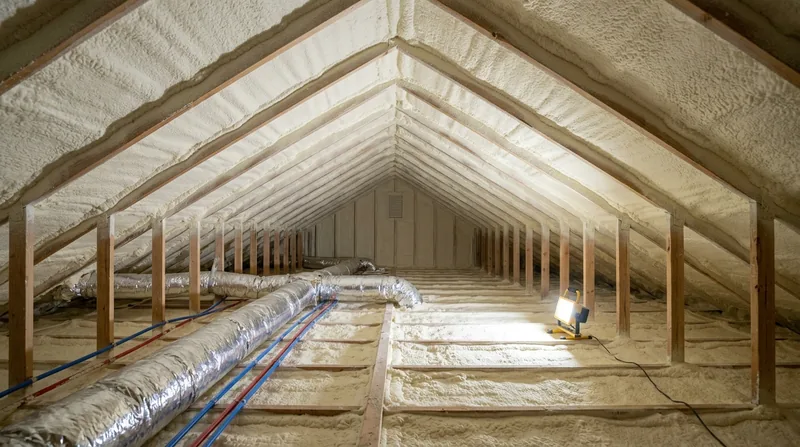




Attic spray foam insulation in Austin transforms a 140 to 160 degree Fahrenheit furnace into conditioned space. Austin sits on the Balcones Escarpment where limestone hills drop to black clay prairie, and nearly every home in the city runs ductwork and water lines through a vented attic that bakes for months on end. From the 1900s Craftsman bungalows of Central Austin and East Austin to the 1950s ranches of Allandale and Crestview, from the vaulted ceilings of Westlake and Lakeway homes overlooking Lake Travis to the new two-stories with bonus rooms over garages in Round Rock, Cedar Park, and Leander, the problem is the same: uncontrolled heat loss in winter, uncontrolled heat gain in summer, and ductwork that sits outside the thermal envelope. Winter Storm Uri in 2021 burst attic water lines across the city. The 2023 ice storm brought down trees on thousands of roofs. Open-cell foam on the roof deck brings that attic inside the building envelope, where ductwork and water lines stay protected and conditioned. Every estimate lists the R-value, thickness per pass, and board footage so you know exactly what you are paying for.
Why Attic Spray Foam Insulation Matters in Austin's Climate and Building Stock
Austin's summers run long and brutal, with 100-degree heat sustained for weeks. A vented attic with fiberglass or blown-in cellulose cannot stop that heat from radiating down through the ceiling into living space below. The ductwork runs hot, the air conditioning system works overtime, and the utility bill climbs. In winter, when a hard freeze hits, the same vented attic becomes a cold sink, and water lines freeze and burst. Spray foam on the roof deck creates an unvented attic where temperature and humidity track the indoors, not the outdoors. Ductwork stays warm in winter and cool in summer. Water lines stay above freezing. The building envelope closes.
- Stops radiant heat gain in summer by sealing the roof deck and eliminating the vented attic cavity.
- Protects ductwork and water lines by bringing them inside the thermal envelope, preventing freeze-ups and condensation loss.
- Improves air conditioning efficiency because cooled air stays in the ducts instead of leaking into unconditioned space.
- Allows mechanical ventilation to be controlled and timed, not passive and weather-dependent.
- Creates a space where roof-mounted solar panels and attic storage do not lose efficiency to temperature swings.
This is the signature job of spray foam insulation in Central Texas, and it is why the product was invented for this climate.
Key info: Winter Storm Uri (February 2021) burst water lines in vented attics across Austin because the attic temperature dropped below 32 degrees while the indoor temperature stayed above 70. An unvented attic sealed with spray foam stays warmer in winter and cooler in summer, protecting both pipes and ductwork. Ask your city building department whether your address requires ventilation inspection or thermal barrier certification for the spray foam system you choose.
How We Perform Attic Spray Foam Insulation in Austin Homes
Every attic is different. A 1920s bungalow in Hyde Park has low roof lines and hand-nailed framing. A 1960s ranch in Brentwood has standard trusses and a mix of failed fiberglass and blown-in fill. A new two-story in Leander has engineered trusses and a clean substrate. We inspect the attic, identify what stays and what comes out, determine whether the roof deck is sound and dry, and then specify the foam system and thickness needed to hit your target R-value. We pull permits if your city requires them, install mechanical ventilation to run during cure, spray to the manufacturer's ratio and drum temperature, and leave the space sealed for twenty-four to forty-eight hours before re-entry. Every estimate lists R-value, thickness per pass, and board footage.
- Schedule a free estimate by calling (737) 404-4885 or using the contact form on our website.
- We inspect the attic, measure square footage, check for moisture, and identify any insulation that needs to come out first.
- We specify the foam type (open-cell or closed-cell), R-value target, and thickness in writing with a firm estimate.
- We coordinate with your city if a permit is required and schedule the work at a time that fits your calendar.
- We install mechanical ventilation, spray the foam to spec, and seal the attic for the cure window.
- We remove ventilation equipment and perform a final walkthrough to confirm coverage and thickness.
The entire process from estimate to finish typically takes one to two weeks, depending on permit timing and your city's requirements. We can discuss insulation removal if your existing fill is wet, settled, or contaminated and needs to come out before we spray.
Example: A 1950s ranch in Barton Hills with a 1,200 sq ft attic, fiberglass settled to R-10, and water damage from a roof leak in one corner. We remove the damaged insulation, repair the roof leak with a roofer, let the substrate dry, then spray 5.5 inches of open-cell foam to R-19.5 across the entire roof deck. The estimate lists board footage, thickness per pass, and R-value. Cure time is 48 hours with mechanical ventilation running. Cost starts at $1.50 per square foot for straightforward jobs like this one.
Spray Foam Insulation Methods for Austin Attics
| Approach | Description | Best for |
|---|---|---|
| Open-Cell Spray Foam | Lower-density foam (0.5 lbs/cu ft) that cures soft and air-permeable. R-value is approximately 3.6 per inch. Absorbs sound. Requires a thermal barrier (drywall or intumescent paint) to meet code. | Attics where cost is the priority and the roof deck is the air barrier. Standard retrofit on 1950s-1970s ranches in Crestview, Allandale, and Brentwood. |
| Closed-Cell Spray Foam | Higher-density foam (1.5 to 2.0 lbs/cu ft) that cures rigid and vapor-impermeable. R-value is approximately 6.0 to 7.0 per inch. Acts as an air barrier and moisture barrier. Requires a thermal barrier depending on foam thickness and local code. | Attics where moisture control is critical or where roof decks have complex geometry. Also used when condensation risk is high or when the attic will be used for storage or a mechanical room. |
| Removal and Replacement | Tear out settled, wet, or contaminated fiberglass or cellulose, clean the substrate, allow it to dry, then spray new foam to spec. Always done before foam is applied to a compromised attic. | Any attic with water damage, pest contamination, or insulation that has failed. Essential prep work for homes in Austin that have experienced roof leaks or freeze damage. |
| Top-Up with Blown-In Insulation | If your existing foam or fiberglass is sound and your R-value is simply low, blown-in cellulose or fiberglass can be added on top without full removal. Faster and cheaper than a complete spray foam retrofit. | Attics where the substrate is clean, the existing insulation is not wet or settled, and you need R-value at a lower cost. Not suitable if you want to eliminate ductwork leakage or seal air bypasses. |
Attic Spray Foam Insulation Cost in Austin: What to Expect
Attic spray foam insulation in Austin starts at approximately $1.50 per square foot for straightforward open-cell jobs on sound roof decks with good access. The actual price depends on several factors: the size of your attic, whether existing insulation needs to be removed, the complexity of the roof geometry, access to the attic space, the R-value you are targeting, and whether your city requires a permit. A typical 1,200 square foot attic might run $1,800 to $2,400 for open-cell foam to R-19.5, or $2,400 to $3,600 for closed-cell foam to the same R-value. Removal of failed insulation adds $0.50 to $1.00 per square foot. Permit and inspection fees vary by city and are your responsibility, though we can help you navigate what applies at your address.
The only way to know your actual cost is to get a written estimate that specifies R-value, thickness per pass, board footage, and any removal or remediation work. We provide free estimates with no obligation, and we recommend getting two or three quotes so you can compare not just price but also scope and warranty. Visit our pricing page for a detailed breakdown of what moves the needle on cost, or call (737) 404-4885 for a quick phone consultation.
Cost example: A 1,500 sq ft attic in Round Rock with settled fiberglass to R-10, no roof leaks, and standard truss geometry. Remove the fiberglass, spray 5.5 inches of open-cell foam to R-19.5, install a thermal barrier where required by code. Estimate: $2,100 to $2,700. A similar attic in Lakeway with a vaulted ceiling, more complex framing, and a requirement for closed-cell foam to R-21: $3,600 to $4,800. Every estimate is custom to your attic.
What to Look for When Hiring a Spray Foam Insulation Contractor Near Austin
Spray foam insulation is a technical trade, and the difference between a good installation and a bad one shows up months later when the smell will not go away, the ductwork still leaks, or the attic is not actually conditioned. When you call any contractor, including us, ask for a written estimate that specifies R-value, thickness per pass, and board footage. Ask whether the estimate includes mechanical ventilation during cure and a stated re-entry window. Ask what happens if the attic substrate is wet or contaminated. Ask whether they pull permits or help you navigate what your city requires. Verify that they carry general liability insurance, and ask to see a certificate of insurance. Check references from homes in your neighborhood. If your attic has protected trees, verify that any exterior work complies with your city's tree ordinance. If you live in a master-planned community, check whether the HOA has architectural rules that apply to exterior work on your roof or attic vents.
- Request a written estimate with R-value, thickness per pass, and square footage or board footage clearly stated.
- Ask whether the contractor is fully insured and request a certificate of insurance before any work begins.
- Verify that the estimate includes mechanical ventilation during cure and a twenty-four to forty-eight hour re-entry window.
- Confirm whether your city requires a permit and whether the contractor helps you understand what applies at your address.
- Get references from at least two recent jobs in Austin and follow up with those homeowners about the installation quality and any issues after completion.
- Ask what happens if the attic is wet or contaminated and whether the contractor will walk away if the substrate is not dry.
The strongest signal of a good installer is an estimate with R-value and thickness specified, a clear process for handling moisture, and a willingness to answer your questions about how the work will proceed. Call us at (737) 404-4885 or use the contact form to request a free estimate and ask any questions about the work.
Attic Spray Foam Insulation in Austin: Pricing Guide
| Service | Price | Details |
|---|---|---|
| Open-Cell Spray Foam (R-19.5) | Starting at $1.50/sq ft | Standard attic retrofit on sound roof deck with good access, includes mechanical ventilation during cure |
| Closed-Cell Spray Foam (R-21+) | Starting at $2.50/sq ft | Higher R-value per inch, vapor barrier included, ideal for complex roof geometry or moisture-prone attics |
| Insulation Removal and Replacement | Add $0.50 to $1.00/sq ft | Removal of settled, wet, or contaminated fiberglass or cellulose before new foam is applied to ensure clean substrate |
| Permit and Inspection | Your responsibility | Varies by city from $50 to $300; we help you understand what your city requires and coordinate with inspectors |
| Travel | Included | No separate mileage fee for Austin and surrounding areas within Greater Austin service territory |
| Free Estimate | No charge, no obligation | Response within 24 hours at (737) 404-4885; written estimate includes R-value, thickness, and board footage |
Indicative pricing, the exact cost depends on square footage, finish, and site access. Free personalized estimate within 24h at (737) 404-4885.


