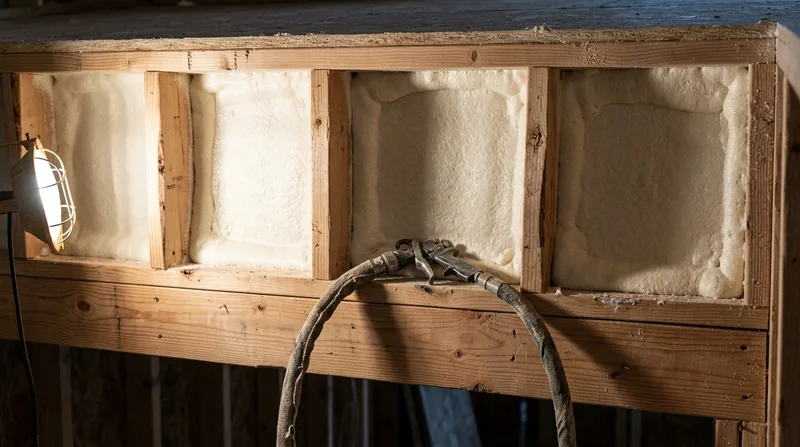




Band joists, rim joists and bonus-room cantilevers over garages are the conditioned-air leak nobody thinks about until the utility bill arrives. These framing cavities sit at the thermal boundary between heated living space and unconditioned attic or garage, and every framing gap, ledger board gap, and rim cavity bleeds warm air in winter and lets cool air escape in summer. In Austin's long, brutal heat season, that loss stacks fast. Rim joist and band joist spray foam seals these cavities with a single closed-cell pass, stops the leak cold, and delivers the fastest comfort payback of any small-ticket insulation job in the city. We have been sealing rim joists and band joists across Austin, Round Rock, Cedar Park, Georgetown and the surrounding areas since 2012, and on a typical 1,500-square-foot home with a bonus room or a second story over a garage, the job takes a day and the comfort improvement is immediate.
Why Rim Joist and Band Joist Sealing Matters in Austin Heat
Austin sits on the Balcones Escarpment where limestone hills drop to black clay prairie, and nearly every home in the city sits on a concrete slab or on pier-and-beam with open crawl spaces below. Above them, attics hit 140 to 160 degrees Fahrenheit through the long string of 100-degree summer days that define Central Texas cooling season. Band joists and rim joists are the wooden frame members that bridge the top of the foundation wall to the subfloor, and they run the entire perimeter of the house. In a typical 1950s ranch in Allandale, Crestview or Brentwood, those rim cavities are empty or filled with fiberglass that has settled and lost its grip. In a newer two-story over a garage in Round Rock, Cedar Park or Leander, the rim cavity is often insulated but never sealed, so air moves through the gaps at the ledger board and the rim board interface, pulling conditioned air straight out of the living space.
- A closed-cell spray foam pass fills every cavity and gap in the rim joist, stopping air leakage at the source.
- Closed-cell foam carries an R-value of 6.5 to 7.0 per inch, so a 1.5-inch pass yields R-10, which is the thermal value of the entire rim cavity.
- The seal is permanent, it does not settle or lose grip, and it requires no maintenance.
- On a home with a bonus room or a second story over a garage, the rim joist job is the fastest comfort win of any insulation retrofit.
Stopping rim joist air leakage is the single most cost-effective way to tighten the thermal envelope of an Austin home with a second story, a bonus room or a cantilever floor.
Key info: A typical bonus-room rim joist in Austin runs 300 to 500 linear feet around the perimeter. At a closed-cell pass of 1.5 inches, that is 37 to 62 board feet, and it seals the entire thermal bridge in a single day. The payback shows up on the next cooling bill.
For more detail on closed-cell foam and its R-value performance, see our closed-cell spray foam insulation page.
How We Seal Your Rim Joist and Band Joist: Our Process in Austin
A rim joist spray foam job starts with a walk of the perimeter to identify all rim cavities, ledger board gaps, band board seams and any existing insulation that needs to stay or come out. We look for moisture, active leaks or wet substrates, and if we find them, we stop and refer you to the right trade. If the rim is dry and ready, we set up mechanical ventilation, mask off any HVAC vents or electrical outlets, and spray the closed-cell foam in a controlled pass that fills the cavity without overfill. The foam cures in 24 to 48 hours, and you can re-enter the attic or bonus room after that window closes.
- We inspect the rim cavity, check for moisture, and confirm the substrate is dry before we spray.
- We set up mechanical ventilation to manage cure-time VOC and ensure safe air quality during and after the spray.
- We spray closed-cell foam at the correct drum temperature and ratio, controlling thickness to specification on every pass.
- We provide a written estimate that names the R-value, the thickness, the board-foot volume and the scope of work.
- We walk you through the re-entry window and post-cure care before we leave the job.
The process is straightforward, the timeline is short, and the result is a sealed thermal boundary that lasts the life of the house.
Example: A Westlake home with a vaulted bonus room over a three-car garage had rim joists on three sides of the bonus floor. The cavity was empty and the ledger board at the roof line had no thermal break. We sprayed 1.5 inches of closed-cell foam into the rim joist, the cantilever band board, and the ledger board interface, sealing 420 linear feet in one day. The homeowner reported a 12-degree drop in bonus-room temperature on the next 100-degree day, and the comfort held through the rest of the summer.
For a full walkthrough of how we approach attic and sealed-space insulation work, see our air sealing page.
Rim Joist Sealing Methods and Approaches
| Approach | Description | Best for |
|---|---|---|
| Closed-Cell Foam Rim Seal | 1.5-inch closed-cell spray foam pass into the rim cavity, sealing all gaps and ledger board interfaces with a rigid, air-tight barrier. | Bonus rooms, cantilever floors, second stories over garages, and any rim joist where air leakage is the primary concern. |
| Rim Cavity Fill with Thermal Barrier | Closed-cell foam spray into an open rim cavity, with a thermal barrier applied to the interior face to meet code fire-rating requirements. | Older homes in Central Austin with empty rim cavities and no existing insulation or fire barrier. |
| Ledger Board Seal | Targeted closed-cell foam application at the ledger board interface where the rim joist meets the roof line or upper floor, sealing the single largest air leak in the rim. | Vaulted ceilings, cathedral ceilings, and bonus rooms where the ledger board runs exposed and uninsulated. |
| Existing Insulation Replacement | Removal of settled or failed fiberglass from rim cavities, followed by closed-cell foam spray to restore R-value and seal all gaps. | 1950s-1960s ranch homes in Brentwood, Allandale, and Crestview where original rim insulation has lost its grip. |
Rim Joist and Band Joist Spray Foam Cost in Austin: What to Expect
A rim joist spray foam job in Austin typically starts at $650 for a small bonus room or a single-story cantilever, and moves upward based on the linear footage of rim to seal, the height and accessibility of the rim cavity, whether existing insulation needs removal, and whether a thermal barrier is required by code at your address. A typical two-story home with a bonus room over a garage will run 400 to 600 linear feet of rim joist, which translates to 50 to 75 board feet of closed-cell foam and a cost in the range of $1,200 to $2,000. The single biggest variable is linear footage, because we charge per board foot and measure on site. A second variable is access: if the rim is tucked under a soffit or behind a brick ledge, the spray takes longer and the cost rises. A third is whether we are removing old insulation first, which adds labor and disposal but is often necessary to restore the cavity to its original depth.
- Linear footage of rim joist is the primary cost driver, because closed-cell foam is priced per board foot and measured on site.
- Accessibility affects labor time, so a rim joist tucked under a soffit or behind masonry costs more than an open rim.
- Removal of existing insulation adds cost but often restores the cavity to its full depth and improves the final seal.
- Thermal barrier application, if required by code at your address, is a separate cost that we specify in the estimate.
- Travel within Austin and surrounding areas is included in the price, with no separate mileage or call-out fee.
The best way to know the real cost is to call us for a free estimate. We will walk the rim, measure the linear footage, identify any prep work, and give you a written quote with R-value, thickness and board-foot detail before we start.
For a full pricing overview across all our services, see our pricing page.
Rim Joist and Band Joist Spray Foam Near Me: What to Look for When Hiring a Contractor in Austin
When you are looking for a spray foam contractor to seal your rim joist in Austin, Round Rock, Cedar Park or anywhere in Greater Austin, the first step is to verify that the contractor you call is fully insured and can provide proof of coverage. The second step is to ask for an estimate that names the R-value per inch, the thickness of the foam, the board-foot volume and the scope of work in writing. The third is to ask whether the contractor will set up mechanical ventilation during cure, and whether they will give you a clear re-entry window. The fourth is to ask about thermal barrier requirements at your address, because the fifteen-minute thermal barrier is a code requirement in some jurisdictions and a critical fire-safety detail that many installers overlook or misname. The fifth is to check that any contractor you hire understands your local building code and can navigate what applies at your address, because permitting and thermal barrier rules vary from city to city across the Austin area and there is no reciprocity between them.
- Ask for a written estimate that specifies R-value per inch, foam thickness in inches, board-foot volume and the exact scope of work.
- Confirm that the contractor will set up mechanical ventilation during cure and provide a re-entry window of 24 to 48 hours.
- Ask about thermal barrier requirements at your address and confirm the contractor understands the difference between a thermal barrier and a fire block.
- Request proof of insurance and confirm coverage limits are adequate for the scope of work.
- If you live in a master-planned community or an HOA, ask whether exterior work or roof-line access requires architectural approval before the job starts.
- Ask the contractor how many rim joist jobs they have completed in your neighborhood or city, and ask for references from homeowners in the same area.
A good contractor will answer all of these questions without hesitation and will provide a written estimate before any work begins.
When you are ready to move forward, contact us for a free estimate or call (737) 404-4885. We will walk your rim joist, answer your questions and give you a written quote with all the detail you need to make the right choice.
Rim Joist & Band Joist Spray Foam in Austin: Pricing Guide
| Service | Price | Details |
|---|---|---|
| Small bonus room or cantilever rim seal | Starting at $650 | Single-story cantilever or small bonus room, 150 to 250 linear feet of rim joist, closed-cell foam fill |
| Two-story home with bonus room over garage | Starting at $1,200 | 400 to 600 linear feet of rim joist across multiple stories and garage cantilever, closed-cell foam and ledger board seal |
| Rim joist with existing insulation removal | Starting at $1,500 | Removal of failed or settled fiberglass from rim cavities, disposal, and closed-cell foam replacement to restore R-value and seal |
| Large or complex rim joist project | On estimate | Multiple cantilevers, vaulted ceilings, ledger board sealing, or thermal barrier requirements that require on-site assessment |
| Travel and mobilization | Included | No separate call-out fee or mileage charge within Austin and surrounding service areas |
| Free written estimate | No obligation | Response within 24 hours at (737) 404-4885, with R-value, thickness, board-foot detail and scope of work |
Indicative pricing, the exact cost depends on square footage, finish, and site access. Free personalized estimate within 24h at (737) 404-4885.


