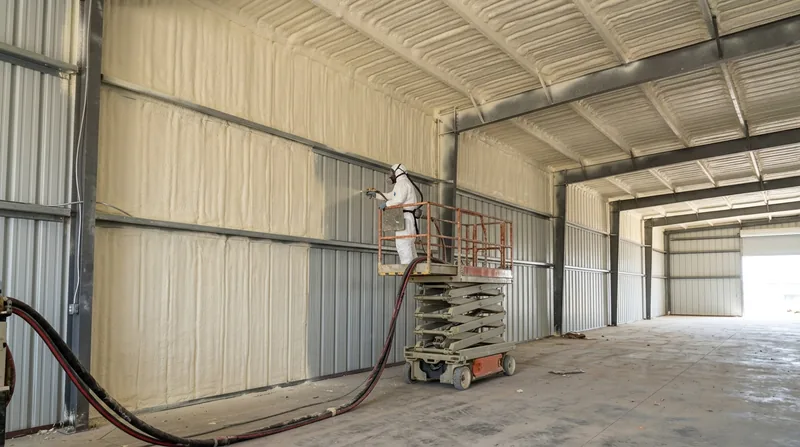




Commercial and new construction spray foam insulation in Austin demands a contractor who understands how warehouses, offices, churches and production facilities operate on schedule. Greater Austin runs from the limestone hills west of MoPac down through the black clay belt of Round Rock, Cedar Park, and Pflugerville, then east to the industrial corridor of Taylor and Hutto where semiconductor fabrication and light manufacturing drive year-round construction. New commercial shells go up fast; existing facilities cannot afford downtime. A spray foam crew that shows up with a permit plan, code-compliant documentation, and the discipline to work in phases keeps your operation running while the insulation work happens around you. We have served this market since 2012 with the technical knowledge and local relationships that turn a complex envelope into a finished, inspectable assembly.
Why Commercial and New Construction Spray Foam Matters in the Austin Market
Austin's commercial real estate runs the full spectrum: adaptive reuse of downtown warehouses built in the 1920s with concrete block and no thermal break; new construction on slab with metal stud framing and open-web trusses; and growth-belt facilities that sit on the edge of the Hill Country where thermal shock between day and night can be thirty degrees. Spray foam solves three problems at once: it seals the air leakage that kills HVAC efficiency, it adds R-value where space is tight, and it controls condensation on metal decks and steel framing where moisture would otherwise wreck the structure. A code-compliant assembly comes with the documentation your building inspector will actually accept, and phased work keeps your tenants, your production line, or your congregation undisturbed.
- We spray closed-cell foam on metal roof decks to stop condensation and add R-value without adding weight to the structure.
- We seal the rim board and band joist on concrete-slab buildings where the thermal bridge between inside and outside runs the full perimeter.
- We remove failed or inadequate insulation and replace it with a new assembly that meets current energy code and passes inspection.
- We work around your schedule with phased spraying that keeps utilities live and occupants safe until the job is done.
- We provide written estimates that name the R-value, the thickness, and the assembly so your inspector knows what he is looking at.
The result is a building envelope that holds temperature, stops air leakage, and protects the structure itself from the thermal stress that dominates the Austin climate.
Key info: Austin summers run 100-plus degrees for weeks at a time, and the attic and roof deck above your facility will hit 140 to 160 degrees. Closed-cell foam on a metal deck stops that heat from radiating into the space below, cuts the cooling load on your HVAC, and prevents the condensation that corrodes fasteners and rusts structural steel. A single metal building in Round Rock or Leander without condensation control will sweat through the night in spring and fall, and the moisture will find every seam.
For permit and code guidance specific to your location, consult your local building department. The City of Austin Building Services publishes energy code requirements and can advise on thermal barrier and ignition barrier rules that apply to your project.
How We Approach Commercial and New Construction Spray Foam in Austin
Every commercial job starts with a site walk and a conversation about what the building actually does. A warehouse in Cedar Park with a metal roof and no attic venting has different needs than a church in Austin with a vaulted ceiling and a historic limestone exterior. We measure the space, identify the thermal boundaries, confirm what code applies at your address, and build an estimate that names the R-value, the foam type, and the thickness. Then we coordinate with your general contractor, your facilities team, and the building inspector so the work fits your schedule and passes inspection the first time.
- We walk the site and document the existing envelope, any moisture issues, and the thermal boundaries that need sealing.
- We confirm what energy code applies at your address and what the local building official requires for thermal and ignition barriers.
- We prepare a written estimate with R-value, thickness, foam type, and the assembly detail so your inspector knows what to expect.
- We coordinate spray dates and times with your operations team so the work does not disrupt tenants, production, or services.
- We provide mechanical ventilation during cure and a clear re-entry window, typically 24 to 48 hours, so your facility can resume normal use safely.
- We attend the building inspection with you so the inspector sees the work and the documentation together.
The result is a finished insulation assembly that your building inspector approves and your facility manager can trust for years to come.
Example: A manufacturing facility in Pflugerville with a 40,000-square-foot metal roof deck and an existing fiberglass layer that had settled and lost R-value. We removed the failed insulation, sealed all the seams and penetrations with closed-cell foam, then sprayed a full closed-cell layer to R-30. The building inspector approved the assembly on the first inspection. The facility manager reported a measurable drop in cooling costs through the summer, and no moisture complaints during the spring and fall thermal swings.
Commercial and New Construction Spray Foam Methods
Spray foam comes in two chemistry families, each suited to different commercial applications. Closed-cell foam is dense, stops moisture and air leakage completely, and adds structural rigidity to metal decks and rim boards. Open-cell foam is lighter, cheaper, and works well for interior wall cavities and attics where moisture control is not the primary driver. The right choice depends on the building use, the envelope assembly, and the code requirements at your address.
| Approach | Description | Best for |
|---|---|---|
| Closed-Cell Foam on Metal Deck | Dense, moisture-resistant foam sprayed directly to the underside of metal roof or wall deck. Typical thickness 2 to 3 inches for R-12 to R-18 per inch. | Metal buildings, warehouses, manufacturing facilities, and any structure where condensation control and air sealing are critical. |
| Closed-Cell Rim and Band Joist Seal | Foam injected into the rim board cavity between concrete slab and first-floor framing. Creates a thermal break and stops air leakage at the perimeter. | New construction on slab and retrofit of existing slab-built facilities where the rim board is the primary thermal bridge to the outside. |
| Open-Cell Foam in Interior Cavities | Lower-density foam sprayed into wall cavities, attic spaces, and drop ceilings. Typical thickness 5 to 6 inches for R-3.5 to R-4 per inch. | Interior office walls, attics over conditioned space, and sound dampening applications where cost and installation speed matter more than moisture control. |
| Removal and Replacement | We remove failed, settled, or inadequate insulation and replace it with a new assembly. Includes disposal and surface prep. | Retrofit of existing commercial buildings where the original insulation has lost R-value or the building code has changed since construction. |
Each method is chosen to match the building envelope, the thermal load, and the code requirements at your address. We discuss the tradeoffs openly: closed-cell is more expensive but solves moisture and adds rigidity; open-cell is cheaper and faster but requires a vapor barrier on the warm side in humid climates. Learn more about closed-cell spray foam and when it makes sense, or explore open-cell options for interior applications.
Commercial and New Construction Spray Foam Cost in Austin: What to Expect
Spray foam pricing for commercial and new construction work is built on the square footage of the envelope, the foam type (closed-cell or open-cell), the thickness required to meet code, and the complexity of the assembly. A metal roof deck in Round Rock is straightforward: measure the area, spray closed-cell to the specified R-value, and move on. A retrofit of a historic warehouse in Austin with irregular framing, multiple penetrations, and existing insulation to remove takes more time and planning, and the price reflects that.
We provide a free commercial estimate. We visit the site, measure the work, confirm the code requirements with your local building department, and deliver a written proposal within 24 hours. The estimate includes the R-value, the thickness, the foam type, and the labor. We do not quote a per-board-foot price in advance because spray foam is measured on site and the actual volume depends on the substrate, the access, and the detail work required.
The biggest factors that move a commercial estimate up or down are the size of the envelope (roof deck square footage), the access (is the space easy to reach or does the crew need scaffolding or lifts), the existing conditions (is there failed insulation to remove, or are we starting on a bare deck), and the code requirements at your address (some jurisdictions require thicker thermal barriers or ignition barriers that add material and labor). A 10,000-square-foot metal roof deck in Leander sprayed to R-20 will cost significantly less per square foot than a 2,000-square-foot retrofit of a downtown Austin office with multiple skylights and mechanical penetrations.
We recommend getting estimates from at least two contractors so you can compare the R-value, the thickness, the foam type, and the labor cost. See our full pricing overview for typical commercial project ranges and what is included at each level. Call us at (737) 404-4885 to schedule your free estimate.
What to Look for When Hiring a Spray Foam Insulation Contractor Near Austin
The spray foam market in Austin includes local independent shops, national franchises, and rig-and-run crews that spray a job in an afternoon and disappear when the smell will not go away or the inspector rejects the work. A good contractor is easy to verify: ask for a written estimate with R-value and thickness, confirm that they will provide mechanical ventilation during cure and a clear re-entry window, ask for references from other commercial jobs they have completed, and check that their insurance is current and can be verified with the carrier.
Permitting and contractor registration vary by city across Greater Austin. The City of Austin, Round Rock, Cedar Park, Georgetown, Pflugerville, and other municipalities in your service area may require a contractor to register before pulling a permit or performing work. Ask any contractor you interview whether they are registered with your city and confirm it with the city building department before work begins. Texas does not issue a state license for insulation work, but your city may require municipal registration, and that requirement is real and it matters.
Check references from at least two commercial projects similar in size and scope to yours. Ask the previous customer about the quality of the work, the professionalism of the crew, whether the job was completed on schedule, and whether the building inspector approved the assembly on the first inspection. Ask whether the contractor was responsive after the work was done if any questions came up.
Confirm that the contractor carries liability insurance and workers compensation. Ask for a certificate of insurance and verify it with the carrier if you have concerns. A contractor who cannot produce proof of insurance is a red flag.
Finally, be wary of any estimate that does not include R-value and thickness, any contractor who promises immediate re-entry without mechanical ventilation during cure, any price that is far below market with no inspection or detail work included, or any contractor who cannot provide verifiable references. These are the markers of a crew that cuts corners and leaves you with a problem. Contact us for a free estimate and let us show you the difference that a local, professional shop makes.
Commercial & New Construction Spray Foam in Austin: Pricing Guide
| Service | Price | Details |
|---|---|---|
| Free commercial estimate | Free | On-site measurement, code review, written proposal with R-value and thickness included, response within 24 hours |
| Metal roof deck spray (closed-cell) | Starting at $1.50 per board foot | Closed-cell foam sprayed to specified R-value on metal roof or wall deck, includes labor and material |
| Rim joist and band board seal | Starting at $4.50 per linear foot | Closed-cell foam injected into rim cavity to create thermal break and stop air leakage at perimeter |
| Interior cavity and attic spray (open-cell) | Starting at $0.75 per board foot | Open-cell foam in wall cavities and attics, includes labor and material at specified R-value |
| Removal and replacement | On estimate | Failed insulation removal, disposal, surface prep, and new assembly installation require site inspection to price accurately |
| Travel and coordination | Included | No separate mileage or travel fee within Austin and surrounding service areas, scheduling flexibility for phased work |
Indicative pricing, the exact cost depends on square footage, finish, and site access. Free personalized estimate within 24h at (737) 404-4885.


