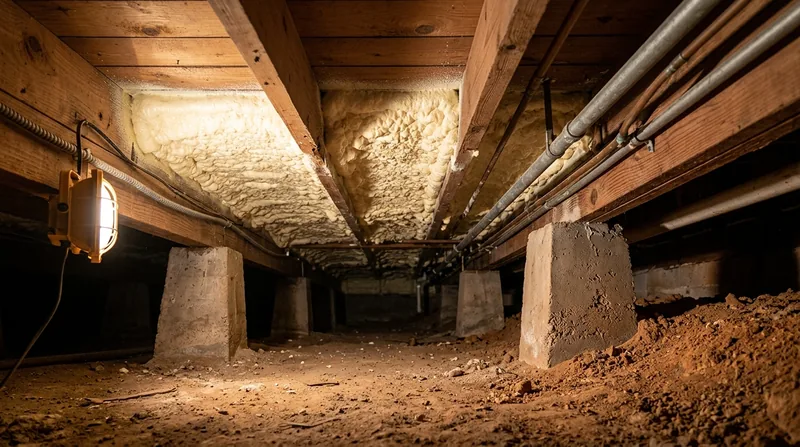




Central Austin's most charming neighborhoods, from Hyde Park to Travis Heights to East Austin, sit on pier-and-beam foundations with open crawl spaces beneath them. Those spaces collect moisture from the black clay soil, trap humid summer air, and let cold winter drafts seep up through the subfloor. Crawl space spray foam insulation in Austin stops that leakage, hardens the floor above, and holds back the moisture and conditioning loss that runs your bills up month after month. We handle the moisture and drainage first, then spray closed-cell foam to seal and insulate. If water is still moving, we walk away. That honesty is the difference.
Why Crawl Space Spray Foam Matters in Austin's Pier-and-Beam Homes
Austin's older housing stock, built from the 1900s through the 1960s, relies on pier-and-beam construction that leaves a gap between the ground and the living space. That gap is your crawl space. In summer, when outdoor humidity climbs to 70 and 80 percent, the unconditioned air in the crawl space pulls moisture into the rim joists, band joists, and subfloor framing. In winter, the same space becomes a cold sink that drafts unheated air into bedrooms and living areas. The Texas ice storms of 2021 and 2023 burst water lines in thousands of crawl spaces across the city. Closed-cell foam on the skirt band and subfloor stops that infiltration, protects the wood, and cuts the load on your air conditioning.
- Sealed crawl spaces hold back humid summer air and reduce cooling strain on the HVAC system.
- Closed-cell foam hardens the subfloor, eliminates cold spots, and stops drafts from below.
- Foam protects rim and band joists from moisture damage and freezing that cracks wood and promotes decay.
- A properly sealed crawl space also serves as a thermal buffer that stabilizes indoor temperature swings.
The payoff is warmer floors, lower humidity inside, and a lower cooling bill from June through September when the heat is relentless. For Austin homeowners, this is not a luxury upgrade, it is a fix for a structural weak point that every pier-and-beam house has.
Key info: A 1920s Craftsman bungalow in Central Austin with a 1,200-square-foot crawl space under 2,000 square feet of living space can lose 30 to 40 percent of its conditioned air through an unsealed subfloor. Closed-cell foam stops that leakage cold.
For more on how closed-cell foam performs and why it is the right choice for crawl spaces, see our page on closed-cell spray foam insulation in Austin.
How We Seal and Insulate Your Crawl Space
The work starts with a walk-through. We look at the crawl space floor, the rim and band joists, the subfloor condition, and any signs of moisture. If standing water, active seepage, or wet soil is present, we tell you what drainage or grading work has to happen first. We do not spray foam over wet substrate. Once the space is dry and prepped, we spray closed-cell foam to a set thickness on the band joist and skirt area, and then across the subfloor deck. Mechanical ventilation runs during application and cure to manage fumes. The foam hardens in 24 to 48 hours, and you stay out of the space during that window. After cure, the crawl space is sealed, insulated, and ready to protect your home for decades.
- We inspect the crawl space for moisture, drainage issues, and structural damage before any foam is ordered.
- We coordinate with you on what moisture correction, if any, is needed before we spray.
- We spray closed-cell foam to a specified R-value and thickness, with a written estimate showing both.
- We run mechanical ventilation during application and cure to ensure safe air quality and proper off-gassing.
- We give you a re-entry window of 24 to 48 hours and explain what to expect as the foam cures.
The result is a sealed, insulated crawl space that holds back moisture and cold and stabilizes your indoor climate.
Example: A home in Bouldin Creek with a damp crawl space and cold subfloor got closed-cell foam on the rim joist and skirt band, plus 2 inches across the subfloor deck. The homeowner reported warmer floors in winter and lower humidity in summer. Total time on site was 4 hours. Re-entry was 48 hours.
If your crawl space also needs air sealing around ductwork or rim joists, visit our air sealing service page for more detail on that scope.
| Approach | Description | Best for |
|---|---|---|
| Closed-cell foam on rim and band joists only | Foam sprayed to the band joist and 12 to 24 inches down the rim, sealing the top perimeter of the crawl space. | Homes where the subfloor is in good condition and moisture is controlled, but perimeter air leakage is the main problem. |
| Closed-cell foam on rim, band, and subfloor deck | Full coverage of the band joist and a 2 to 4 inch layer across the entire subfloor, creating a complete thermal and moisture barrier. | Pier-and-beam homes with cold floors, high humidity, or frequent moisture in the crawl space. |
| Closed-cell foam with interior rim insulation | Foam applied to the interior face of the rim joist and band, plus subfloor coverage, for maximum R-value in tight spaces. | Homes where exterior access is limited or where the rim joist sits close to the grade line. |
| Closed-cell foam with drainage and grading prep | We identify needed moisture control work, refer you to the right specialist, and spray once the crawl space is dry and prepped. | Crawl spaces with standing water, active seepage, or poor surface grading that must be corrected before insulation can work. |
Crawl Space Spray Foam Insulation Cost in Austin: What to Expect
Crawl space spray foam insulation in Austin starts at around $2,500 to $4,500 for a typical 1,000 to 1,500 square foot crawl space with foam on the rim joist, band, and partial subfloor coverage. The final price depends on the crawl space size, how much of the subfloor you want covered, the R-value you are targeting, access difficulty, and whether any moisture prep work is needed first. A full subfloor deck at 4 inches of closed-cell foam will cost more than rim and band only. A crawl space with poor access, low headroom, or complex geometry will take longer and cost more. The best way to know what your job will run is to get a written estimate with R-value and thickness specs. We give those free, and you should get at least two or three so you can compare apples to apples.
For a detailed pricing overview and examples across different service types, visit our full pricing page.
What to Look for When Hiring a Spray Foam Insulation Contractor Near Austin
Spray foam is a good product when it is installed right, and it is a problem when it is not. The difference is in the contractor you hire. A good spray foam installer near Austin will show up with a clear process, a written estimate that names R-value and thickness, mechanical ventilation during cure, and a willingness to walk away if the substrate is wet or contaminated. A bad one will quote a price with no specs, spray in an afternoon with no ventilation, promise re-entry the same day, and disappear when the smell will not go away or the foam is too thick or too thin. Here is how to vet any contractor, including us.
- Ask for a written estimate that lists the R-value, the thickness in inches, and the square footage being covered.
- Verify that the contractor carries general liability insurance and ask to see the certificate of insurance.
- Ask how they manage fumes during application and cure, and what re-entry window they guarantee.
- Check references from homes in your area and ask those homeowners about the install, the smell, and any issues after.
- Call the city of Austin or your local building department to ask what registration or permits apply to insulation work at your address.
- Ask the contractor whether they have worked in your city before and what they know about local permitting and code.
A contractor who answers these questions clearly and without hesitation is one you can trust. One who dodges them or quotes a price off the cuff is not. You can reach us at (737) 404-4885 for a free estimate and to ask any of these questions yourself.
Crawl Space Spray Foam Insulation in Austin: Pricing Guide
| Service | Price | Details |
|---|---|---|
| Rim joist and band joist foam only | Starting at $2,500 | Closed-cell foam on the perimeter band and rim joist, sized to your crawl space length and height |
| Rim, band, and partial subfloor coverage | Starting at $3,500 | Foam on band joist plus 2 inches across 50 percent of the subfloor deck, typical for medium-sized crawl spaces |
| Full crawl space insulation with complete subfloor | Starting at $4,500 | Closed-cell foam on rim joist, band, and full subfloor deck at 2 to 4 inches, depends on crawl space size and R-value target |
| Crawl space with moisture prep or difficult access | On estimate | Jobs requiring drainage work, grading correction, or very tight headroom need an on-site inspection before pricing |
| Travel and site visit | Included | No mileage fee or travel charge in Austin and the surrounding Greater Austin service area |
| Free written estimate | Free | Response within 24 hours at (737) 404-4885, with R-value and thickness specs, no obligation to book |
Indicative pricing, the exact cost depends on square footage, finish, and site access. Free personalized estimate within 24h at (737) 404-4885.


