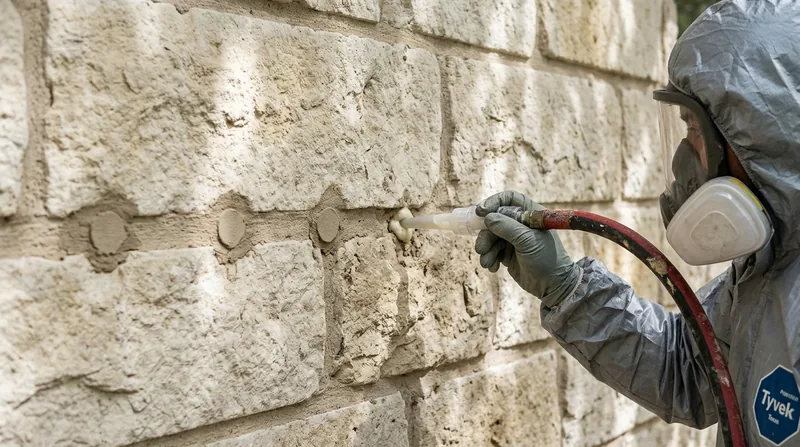




Austin's 1950s and 1960s ranch homes, the brick and limestone-veneered ranches that fill Crestview, Brentwood, Allandale and Barton Hills, were built with empty wall cavities that offer no thermal resistance. The older frame Craftsman bungalows of Central Austin, raised on pier-and-beam over open crawl spaces, sit behind wood siding with hollow walls that leak heat and cool air directly to the outside. Wall and injection foam insulation fills those closed cavities without tearing out drywall or veneer, sealing the thermal envelope from the inside and stopping the temperature swing that costs money every month. The retrofit answer for Austin's aging housing stock is a small-diameter injection rig, controlled foam expansion, and ports patched to match. We've worked in this market since 2012, and we know the wall construction that dominates here: we know what works, what doesn't, and when to walk away from a bad substrate. Here's how injection foam solves the problem.
Why Wall & Injection Foam Insulation Matters in Austin's Aging Homes
Austin's building stock tells the story. The 1950s ranch with brick veneer over empty cavities is the single biggest target for injection foam retrofit in this market. The wall cavity sits between the exterior veneer and the interior drywall with nothing in it, no fiberglass, no cellulose, no resistance. In summer, that wall absorbs heat from the outside and radiates it inward. In winter, conditioned air leaks out through the same cavity. The result is a thermal bridge that runs the length of your home, and your HVAC system runs longer and hotter to compensate. Injection foam fills those cavities completely, stops air infiltration, and restores the thermal boundary where it should be.
- We drill small ports (typically 1.5 to 2 inches) through the brick or veneer at strategic intervals, spaced to ensure even foam distribution across the entire cavity depth.
- Closed-cell or open-cell foam is injected under controlled pressure to expand and fill the cavity without over-pressurizing the wall assembly.
- Ports are patched with matching mortar or caulk, leaving no visible evidence of the work once cured.
- The result is a sealed, insulated wall cavity with R-values between R-3.6 and R-7 per inch, depending on foam type and thickness achieved.
- No drywall removal, no interior disruption, no weeks of reconstruction, the work is done in a day or two, and your home is immediately more efficient.
Injection foam is the only retrofit answer for walls that cannot be opened without destroying the home's exterior or interior finish.
Key info: A 1,500-square-foot ranch in Brentwood with 1,200 linear feet of exterior wall cavities typically requires 400 to 600 board feet of injection foam, depending on cavity width and desired R-value. The work takes two to three days and costs between $3,600 and $7,200 before any local permits or inspections.
For more information on how foam insulation works in different applications, see our closed-cell spray foam insulation page.
How We Install Wall & Injection Foam Insulation in Austin
The process begins with a walk-around and an honest assessment of the wall cavity. We measure cavity width, check for existing moisture, verify that the substrate is sound, and plan port locations to achieve even foam distribution without over-pressurizing the wall. We use a laser level and a chalk line to mark port centers on the exterior veneer, drill carefully to avoid hitting rebar or structural members, and then inject foam in a sequence that ensures complete fill without voids. The foam expands slightly beyond the cavity to seal around any obstructions, then cures to a rigid, closed structure. Ports are then patched to match the existing finish.
- We conduct a pre-injection site visit to measure cavity dimensions, assess moisture conditions, and identify any structural or mechanical obstructions within the wall.
- We mark and drill injection ports at calculated intervals, typically 16 to 24 inches on center, ensuring even foam distribution across the full cavity depth.
- We inject closed-cell or open-cell foam at the proper drum temperature and manufacturer ratio, monitoring expansion and pressure to prevent wall damage.
- We allow the foam to cure for 24 to 48 hours before patching ports, and we recommend mechanical ventilation during the cure period to manage off-gassing.
- We patch all ports with color-matched mortar, caulk, or sealant, so the exterior veneer shows no trace of the work when finished.
The entire process is non-invasive and leaves your home's interior and exterior appearance unchanged.
Example: A Cedar Park Craftsman cottage with wood-sided frame walls and no original insulation received injection foam across 800 linear feet of exterior walls. The cavity was 3.5 inches deep and had never been filled. We drilled 42 ports, injected 320 board feet of closed-cell foam over two days, and patched all ports with stained exterior caulk. The homeowner saw a measurable drop in heating and cooling costs within the first month, and the work was invisible from the street.
For a detailed look at the full scope of air sealing that often accompanies injection foam, visit our air sealing page.
Wall & Injection Foam Methods & Approaches
| Approach | Description | Best For |
|---|---|---|
| Closed-Cell Injection Foam | Rigid, moisture-resistant foam with R-7 per inch; expands to fill the cavity and creates an air barrier; cures in 24 hours. | Walls with moisture risk, high-performance retrofit, or cavities that need maximum R-value in minimum thickness. |
| Open-Cell Injection Foam | Semi-rigid, breathable foam with R-3.6 per inch; lower density and cost; allows vapor transmission; cures in 48 hours. | Older frame homes with wood siding where vapor permeability is preferred, or budget-conscious retrofit of non-critical walls. |
| Partial-Fill Injection | Foam injected to 60 to 70 percent of cavity depth, leaving room for settling or future inspection; reduces material cost and curing time. | Secondary walls, lower-priority areas, or when budget constrains full-fill retrofit. |
| Full-Cavity Injection | Foam fills 100 percent of cavity depth from header to footer, creating maximum R-value and complete air sealing throughout the wall assembly. | Primary living spaces, exterior-facing walls in hot or cold climates, or when energy performance is the top priority. |
Wall & Injection Foam Insulation Cost in Austin: What to Expect
Wall and injection foam insulation in Austin typically starts at $2 to $4 per square foot of wall area treated, depending on cavity width, foam type, accessibility, and the distance between ports. A 1,500-square-foot ranch home with 1,200 linear feet of exterior wall cavities averaging 3.5 inches deep will require between 400 and 700 board feet of foam, placing the total cost between $3,200 and $8,400 including labor, equipment, and port patching. Closed-cell foam costs more than open-cell but delivers higher R-value and moisture resistance. Access difficulty, the presence of obstructions within the cavity, and the need for interior patching can increase the per-square-foot rate. We always provide a written estimate with R-value specifications, thickness targets, and a board-foot count so you know exactly what you're paying for and why.
Several factors move the cost up or down. Cavity width is the first: a 5.5-inch cavity holds more foam than a 3.5-inch cavity, so the board-foot count rises. Foam type matters: closed-cell runs higher per board foot but achieves R-7 per inch, while open-cell is cheaper but delivers R-3.6 per inch, so you may need more thickness to hit the same target R-value. Accessibility affects labor time: if the wall is easily reached from the ground and has a clear, unobstructed cavity, the work moves faster and costs less. If the wall is blocked by landscaping, deck structures, or interior built-ins, port drilling and injection take longer. Finally, the quality of the exterior finish, whether it's brick, limestone, stucco, or wood siding, determines how much time patching takes and whether specialized color-matching materials are needed. Get estimates from at least two contractors, and make sure each one specifies the foam type, the R-value per inch, the target thickness or board-foot count, and the warranty on workmanship. For detailed pricing on all our services, see our pricing page.
Wall & Injection Foam Insulation Near Me: What Austin Homeowners Should Know When Hiring
Hiring a spray foam contractor for wall injection requires the same due diligence you'd apply to any major home improvement. Ask any contractor you're considering whether they carry general liability and workers' compensation insurance, and ask them to provide proof of current coverage before they set foot on your property. Check with the City of Austin, Round Rock, Cedar Park, Georgetown, or whichever municipality covers your address to understand whether a contractor registration or permit is required for insulation work in your jurisdiction. Texas does not license spray foam insulators at the state level, but many cities do require contractor registration before work begins, and that registration is real and enforceable. Verify that any contractor you hire holds that registration with your local building department. Ask for references from work completed in your neighborhood within the past two years, and call at least two of them to ask about the quality of the work, the professionalism of the crew, and whether any issues arose after completion. Get a written estimate that includes the foam type, the R-value specification, the target thickness or board-foot count, the port locations and patching plan, and the timeline for cure and re-entry. Be wary of estimates that promise immediate re-entry or that omit technical specifications, those are red flags. If your property is in a master-planned community or an HOA, check the architectural guidelines to see whether any approval is needed for exterior work, particularly if port drilling will be visible on the facade.
- Confirm that any contractor you hire carries current general liability and workers' compensation insurance and can provide a certificate of insurance before work starts.
- Ask your contractor to verify that they hold any contractor registration or business license required by your city, and confirm that registration with your local building department yourself.
- Request a written estimate that specifies the foam type (closed-cell or open-cell), the R-value per inch, the target thickness or total board feet, and the warranty on workmanship.
- Call at least two references from completed work in your area within the past two years, and ask about the quality of the finish, the professionalism of the crew, and any issues that arose after cure.
- Check your HOA architectural guidelines or your local building code to determine whether any approval or inspection is required for the wall injection work.
- Understand the cure timeline: closed-cell foam typically cures in 24 hours, open-cell in 48 hours, and mechanical ventilation should run during that period to manage off-gassing.
The right contractor will answer your questions directly, show you their insurance, explain the technical details without jargon, and give you a realistic timeline and price before any commitment is made. Contact us for a free estimate, and we'll walk you through the entire process.
Wall & Injection Foam Insulation in Austin: Pricing Guide
| Service | Price | Details |
|---|---|---|
| Open-Cell Injection Foam | Starting at $2/sq ft | Breathable foam, R-3.6 per inch, ideal for frame homes and budget-conscious retrofit work. |
| Closed-Cell Injection Foam | Starting at $3.50/sq ft | Rigid, moisture-resistant foam, R-7 per inch, best for high-performance retrofit and moisture-prone walls. |
| Full-Cavity Fill (1,000+ sq ft) | On estimate | Cavity width, foam type, access difficulty, and exterior finish determine final cost; typically 400 to 800 board feet per 1,200 linear feet of wall. |
| Port Patching & Finish | Included | Color-matched mortar, caulk, or sealant applied to all ports; no additional charge for standard exterior finishes. |
| Travel & Site Visit | Included | Free site assessment and written estimate throughout Austin and surrounding service areas, no mileage fee or travel surcharge. |
Indicative pricing, the exact cost depends on square footage, finish, and site access. Free personalized estimate within 24h at (737) 404-4885.


