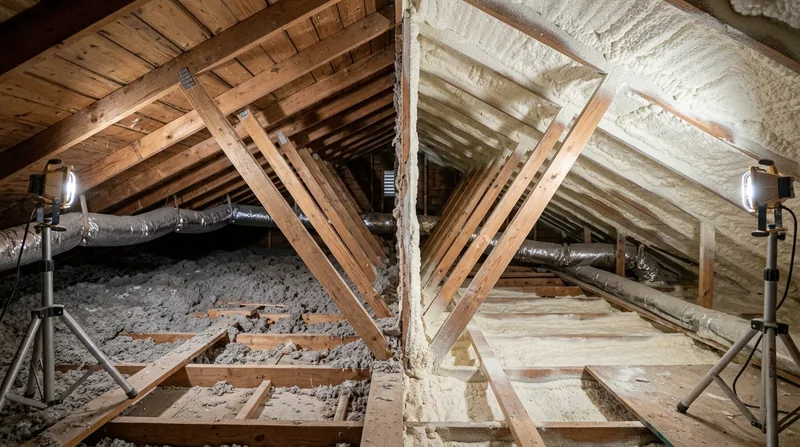




Austin sits on the Balcones Escarpment where limestone hills drop to black clay prairie, and nearly every home above that terrain runs ductwork and water lines through a vented attic that hits 140 to 160 degrees Fahrenheit during long stretches of 100-degree summer days. Over time, that heat and humidity flatten fiberglass batts, soak blown-in cellulose when a frozen pipe bursts or a roof leak develops, and leave insulation performing at a fraction of its original R-value. Insulation Replacement and Re-Insulation in Austin is the full reset: we remove the failed material, air-seal the gaps that let conditioned air escape, and install new foam to current code R-values. It is the right call when insulation is twenty years past its job, when it is soaked by a frozen pipe or roof leak, or when it has been flattened by settling and age.
Why Insulation Replacement and Re-Insulation Matters in Austin's Climate
Austin's brutal summer heat and occasional hard freezes create two distinct failure modes in attic insulation. The long 100-degree days compress fiberglass batts and bake out the air pockets that give them their R-value, while winter ice storms like the 2023 event and the 2021 Winter Storm Uri burst water lines in attics and soak insulation from above. Once insulation is wet or compressed, it stays compromised even after it dries. A flattened attic or one with standing water in the foam is no longer controlling heat transfer, and your air conditioning system works overtime to cool a home that is already losing conditioned air through every gap and bypass.
- Compressed or settled insulation loses R-value and allows heat to conduct through the attic directly into living space.
- Wet insulation from a roof leak or frozen pipe never recovers its original thermal resistance, even when dry.
- Air leaks around ductwork, penetrations and the rim joist bypass new insulation entirely if not sealed during replacement.
- Spray foam adheres to the substrate and does not settle, compress or absorb moisture the way blown-in fiberglass or cellulose does.
- A properly sealed attic with closed-cell foam reduces the load on your air conditioning system and keeps conditioned air inside the home.
The City of Austin's building code sets minimum R-value requirements for attic insulation based on the cooling load in your climate zone, and a full replacement ensures you meet or exceed those standards for your address. For guidance on what applies to your home, contact the City of Austin Development Services office or visit their Development Services website.
Key info: A 1950s ranch in Crestview or Allandale with original fiberglass batts and a vented attic is the most common replacement candidate in Austin. Those homes often have empty wall cavities and flattened attic fill that lets summer heat conduct straight through to the living space below.
How Insulation Replacement and Re-Insulation Works in Austin Homes
The replacement process is straightforward: we remove the old, failed material to the substrate, identify and seal air leaks around ductwork and penetrations, then install new foam to the R-value required by code for your address. In an attic, we work from the underside of the roof deck or from the attic floor, depending on whether you want a sealed (unvented) attic or a traditional vented space with foam on the floor. We control the spray temperature and drum ratio to the manufacturer specification, apply foam in uniform passes to avoid over-packing, and ensure mechanical ventilation during the cure period. Re-entry time is typically twenty-four to forty-eight hours, after which the space is safe to occupy and the foam is fully cured.
- We haul out all old insulation, debris and any contaminated material to a licensed disposal facility.
- We identify and seal rim joists, band joists, ductwork penetrations and other air leaks with spray foam or sealant.
- We apply new foam in controlled passes to the thickness and R-value specified on your estimate.
- We ensure proper ventilation during cure and provide a re-entry window in writing before we leave the job.
- We inspect the finished foam for coverage, thickness and adhesion to the substrate before final walkthrough.
In a 1940s Craftsman bungalow in Hyde Park or Clarksville with a pier-and-beam foundation, the crawl space underneath is often the better place to start, because the open space below the floor is where cold air infiltrates and where water can pool during heavy rain. A full crawl space spray foam insulation job seals that boundary and makes the attic work much more efficient.
Local example: A West Lake Hills home with a vaulted ceiling over the great room cannot use traditional blown-in insulation on the attic floor because the space is too tight to access. Spray foam on the underside of the roof deck creates a sealed attic and gives you R-value where blown-in fiberglass cannot go.
Methods and Materials for Insulation Replacement and Re-Insulation
| Approach | Description | Best for |
|---|---|---|
| Closed-cell spray foam on roof deck | High-density foam applied to the underside of roof sheathing, creating a sealed attic. R-value approximately 6.5 per inch. Adheres firmly and does not compress or settle. | Vaulted ceilings, sealed attics, homes where vented attics allow too much heat transfer, retrofits where access is limited. |
| Open-cell spray foam on attic floor | Lower-density foam applied over the attic floor joists. R-value approximately 3.6 per inch. Cheaper than closed-cell and sufficient for attic floor applications in Austin. | Traditional vented attics where the space is accessible and you want to keep the vented boundary. |
| Full removal plus closed-cell rim and band joist sealing | Complete tear-out of old insulation combined with closed-cell foam on the rim joist and band joist where the house sits on the foundation. Stops infiltration at the thermal boundary. | Homes with air leaks at the rim, slab-built two-stories with bonus rooms, any replacement where infiltration is a known issue. |
| Attic floor plus wall injection foam retrofit | Open-cell or closed-cell foam applied to the attic floor combined with injection foam into exterior wall cavities. Addresses both horizontal and vertical thermal boundaries without demolition. | Pre-1980 stock with empty wall cavities, Craftsman bungalows, homes where wall insulation was never installed. |
Insulation Replacement and Re-Insulation Cost in Austin: What to Expect
Insulation replacement in Austin typically starts at $2,800 for a modest attic top-up or a single-story home with straightforward access and no major air-sealing work. From there, cost scales with the size of the attic, the depth of foam required to meet code R-values for your address, whether you are sealing a crawl space or rim joist at the same time, and the condition of the substrate. A 1950s ranch in Barton Hills with a 1,200-square-foot attic, vented originally and now being converted to a sealed attic with closed-cell foam, runs higher because of the material cost and the labor to spray the entire roof deck. A simple top-up of a sound attic in Round Rock with blown-in cellulose or open-cell foam on the floor is less expensive. Access matters: a home with a tight attic entry or ductwork in the way costs more to mobilize and work in than one with an easy attic pull-down and clear space.
The best way to understand what your home will cost is to request a free estimate. We measure the attic on site, identify the air leaks and substrate condition, check the code R-value for your zip code, and give you a written estimate with the R-value and thickness specified so you know exactly what you are paying for. We will also tell you if a simpler approach is the right answer: sometimes a top-up with blown-in fiberglass on a sound attic is the cheaper and smarter choice than a full replacement.
For a full breakdown of pricing across all service types and job sizes, see our pricing page.
Insulation Replacement and Re-Insulation Near Me: What Austin Homeowners Should Know When Hiring a Contractor
Hiring the right spray foam contractor is about more than price. Contractor registration requirements vary by city across Greater Austin, so before you book any work, ask the contractor whether they are registered with your city and verify that registration directly with the city development or permitting office. The City of Austin, the City of Round Rock, the City of Cedar Park and other municipalities each maintain their own contractor rolls, and there is no reciprocity between them. A contractor registered in Austin may not be registered in Cedar Park, and vice versa. Equally important: understand whether your job needs a permit. Most attic insulation does not, but if you are converting a vented attic to a sealed attic or if you are adding insulation to a historic home in a protected district, the local building official may require a permit and inspection. Ask your contractor to tell you what applies to your address, and if they do not know, ask them to call the building department with you.
- Get written estimates from at least two contractors, each with R-value and thickness specified so you can compare apples to apples.
- Ask for proof of insurance and verify coverage limits directly with the insurance company, not the contractor's word.
- Check references from recent jobs in your neighborhood: call them and ask whether the contractor was clean, whether the smell was manageable, and whether they were reachable if a problem came up.
- Ask the contractor to explain the re-entry window and the ventilation plan during cure. If they promise immediate re-entry or no smell, they are not planning to do the job right.
- Confirm the contractor understands the permit and registration requirements for your specific city and address.
When you are ready to move forward, contact us at (737) 404-4885 or use our contact form to schedule your free estimate. We will respond within 24 hours, walk through your home, explain what the job will cost and why, and answer every question before you decide to book.
Insulation Replacement & Re-Insulation in Austin: Pricing Guide
| Service | Price | Details |
|---|---|---|
| Attic floor top-up (open-cell foam) | Starting at $2,800 | Small attic with accessible floor space, no major air sealing, straightforward removal of old material |
| Sealed attic conversion (closed-cell foam on roof deck) | Starting at $4,500 | Roof deck spray, full air sealing, sealed attic with vaulted ceiling or bonus room, requires higher material cost |
| Full attic replacement plus rim joist and crawl space sealing | Starting at $6,200 | Complete removal, attic floor or roof deck spray, rim joist and band joist sealing, crawl space boundary treatment included |
| Complex or multi-space job (attic plus walls plus crawl space) | On estimate | Requires on-site inspection to assess substrate, access, square footage and air-sealing scope before pricing |
| Travel and mobilization | Included | No separate charge for jobs in Austin and surrounding service areas within Greater Austin |
| Free written estimate | No obligation | Response within 24 hours at (737) 404-4885, includes R-value and thickness specs, no pressure to book |
Indicative pricing, the exact cost depends on square footage, finish, and site access. Free personalized estimate within 24h at (737) 404-4885.


