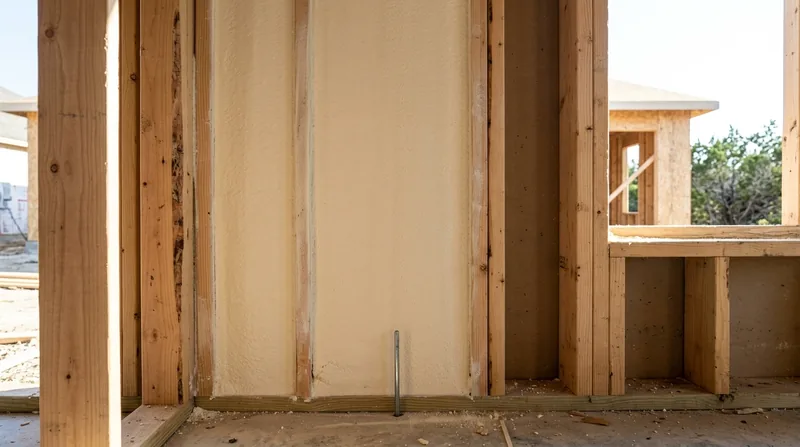




Closed cell spray foam insulation in Austin delivers R-6.5 per inch with its own vapor retarder and real structural stiffening, making it the right product for the specific challenges Austin homes and metal buildings face. The Balcones Escarpment drops limestone hills into black clay prairie, and the homes that sit on those sites run from 1900s Craftsman bungalows on pier-and-beam to modern slab-built two-stories with bonus rooms over garages. Above nearly all of them, ductwork and water lines run through vented attics that hit 140 to 160 degrees Fahrenheit on long strings of 100-degree summer days. Winter brings hard freezes, too. Winter Storm Uri in 2021 burst attic water lines across the city; the 2023 ice storm brought down trees on thousands of roofs. Closed cell foam handles both extremes, seals the air leaks that bleed conditioned air into the unconditioned space, and stops the thermal shock that kills poorly insulated walls. For barndominiums, metal shops, and ranch buildings out past the suburbs in Dripping Springs, Bastrop, and Liberty Hill, closed cell foam is the only answer to condensation on steel.
Why Closed Cell Spray Foam Matters in Austin's Heat and Freeze Cycles
Austin's climate swings hard. Summer heat bakes the black clay and limestone, pushing attic temperatures to the point where fiberglass insulation compresses, settles, and loses contact with the joists it is supposed to cover. Winter freezes hit fast and hard enough to burst water lines inside uninsulated attic spaces. Closed cell foam solves both. Its high density and vapor-tight seal prevent the air leakage that turns an attic into a convection oven in August and a frost chamber in February. The structural stiffening matters on metal buildings and barndominiums, where condensation on steel framing is the failure mode that dominates. Open cell foam absorbs moisture; closed cell foam rejects it.
- Two-pound closed cell foam delivers R-6.5 per inch with its own vapor retarder built in.
- Sealed roof decks in attics eliminate the need for soffit and ridge vents, stopping hot attic air from leaking into living spaces.
- Metal buildings and barndominiums stay dry because closed cell foam prevents condensation that would otherwise form on the steel frame.
- Pier-and-beam subfloors and rim joists in Central Austin homes get real moisture control and structural support without the settling that fiberglass suffers.
- Wall cavities in pre-1980 Craftsman cottages and bungalows retrofit without demolition, handling both August heat and hard freezes without air gaps.
These are the jobs where closed cell foam is not just better, it is the only right answer.
Key info: Austin's building code at your address governs attic ventilation, ignition barriers, and thermal barriers. The fifteen-minute thermal barrier distinction is the one most installers get wrong. Always check with your local building department to confirm what applies to your property before any work begins.
How We Install Closed Cell Spray Foam Insulation in Austin Homes and Metal Buildings
Closed cell spray foam is applied in multiple thin passes, not one thick pour. Each pass is controlled for thickness, the equipment is set to the manufacturer ratio and drum temperature, and mechanical ventilation runs during the cure. This is where the work separates good installers from the rest. A crew that promises immediate re-entry or skips ventilation is cutting corners, and the smell and off-gassing will haunt the building for months. We spray in controlled passes, we ventilate the space for the full cure window, and we state a re-entry time of twenty-four to forty-eight hours. On sealed attics, we seal the air leaks first (rim joists, band joists, ductwork penetrations, wiring chases), then apply the foam to the roof deck. On metal buildings and barndominiums, we spray the underside of the roof and the exterior walls, stopping condensation before it starts. On pier-and-beam crawl spaces and subfloors in older Austin homes, we spray the rim joist and band joist, then move to the walls and the underside of the floor system. Each job is different, and the estimate walks you through what we find and why.
- We inspect the attic, crawl space, or wall cavity for moisture, contamination, or damage that must be addressed before foam can be applied.
- We air-seal all penetrations and gaps with foam, caulk, or mechanical fasteners so that the thermal barrier is complete.
- We apply closed cell foam in thin, controlled passes, checking thickness and coverage as we go.
- We run mechanical ventilation during the entire cure window to ensure proper off-gassing and cure.
- We confirm re-entry conditions with you and provide written guidance on when the space is ready for occupancy.
This is the process that separates a professional installation from a quick spray job that leaves you with an odor problem.
Example: A 1950s ranch in Allandale with empty wall cavities between the brick veneer and the interior drywall. Temperatures inside the wall swing 60 degrees Fahrenheit between summer and winter. We inject closed cell foam into the cavities without removing drywall, seal the air leaks at the rim joist and the top plate, and the wall cavity becomes a conditioned space. The homeowner gets better comfort, lower bills, and no demolition. See our wall and injection foam page for more on this retrofit.
Closed Cell Spray Foam Insulation Methods and Applications
| Approach | Description | Best for |
|---|---|---|
| Sealed roof deck spray | Closed cell foam applied directly to the underside of the roof sheathing, eliminating soffit and ridge vents and creating a conditioned attic space. | Attics with ductwork and water lines, homes in Austin and Round Rock where attic temperatures exceed 150 degrees. |
| Wall cavity injection | Closed cell foam injected into empty wall cavities between exterior sheathing and interior drywall without removing drywall. | Pre-1980 Craftsman homes, brick-veneer ranches, any wall that needs both thermal and moisture control. |
| Metal building and barndominium spray | Closed cell foam sprayed on the underside of the roof and exterior walls to prevent condensation on steel framing and insulate the space. | Barndominiums in Dripping Springs, metal shops in Bastrop, ranch buildings in Liberty Hill, any structure where condensation on steel is a risk. |
| Rim and band joist sealing | Closed cell foam applied to rim joists and band joists on pier-and-beam foundations, sealing the air leak where the house meets the crawl space. | Central Austin homes, Hyde Park, Travis Heights, any pier-and-beam house with an open crawl space below. |
| Crawl space wall spray | Closed cell foam applied to crawl space walls and the underside of the floor system, creating a thermal and moisture barrier. | Crawl spaces with high humidity, homes near water tables, any space where moisture control is essential. |
Closed Cell Spray Foam Insulation Cost in Austin: What to Expect
Closed cell spray foam insulation in Austin starts at around $1.20 per board foot on average jobs, with most residential attic and wall applications running between $1.50 and $2.50 per board foot depending on the scope, access, and the substrate. A sealed attic on a 2,000-square-foot home might run 3,000 to 4,000 board feet, putting the job in the $4,500 to $10,000 range. A wall cavity retrofit on a single room is smaller, often 500 to 800 board feet. Metal buildings and barndominiums vary widely based on height, roof pitch, and wall area. The biggest factors that move the price up are difficult access (steep roofs, tight crawl spaces), existing insulation that must be removed first, moisture issues that need to be addressed before foam can be applied, and the size of the job. Getting two or three estimates is smart, and each one should specify the R-value, the thickness per pass, the total board feet, and the re-entry window. If an estimate is missing those details, ask for them. If the price is far below market with no inspection, walk away. See our pricing page for more detail on what affects the cost.
Closed Cell Spray Foam Insulation Near Me: What Austin Homeowners Should Know Before Hiring
Spray foam insulation is not a licensed trade in Texas at the state level, but contractor registration is municipal and it is real. The City of Austin, Round Rock, Cedar Park, Georgetown, and other cities in the service area each have their own contractor registration and permitting rules. Before you hire any spray foam contractor, including us, ask for the registration your city requires and verify it with the city's building department. Fully insured is not optional, and you should ask for a certificate of insurance naming your property as an additional insured. Get multiple estimates, and compare them on R-value, thickness, board feet, and the re-entry window, not just the bottom line price. Check references, and ask to speak with a homeowner who had the same type of job done. If the job involves a sealed attic or a wall in a historic neighborhood, confirm what the building code and the local historic district guidelines require before work starts. If your home is in an HOA, check the architectural rules on exterior work, especially on metal buildings or barndominiums. Call us at (737) 404-4885 for a free estimate, and we will walk you through what applies at your address and why.
Ready to get started? Contact us for a free, no-obligation estimate and let us show you what closed cell spray foam can do for your Austin home or metal building.
Closed Cell Spray Foam Insulation in Austin: Pricing Guide
| Service | Price | Details |
|---|---|---|
| Sealed attic with closed cell foam | Starting at $1.20/board ft | Includes air sealing, foam application in controlled passes, and mechanical ventilation during cure on typical residential attics |
| Wall cavity injection retrofit | Starting at $1.50/board ft | Closed cell foam injected into empty wall cavities without drywall removal, price varies by wall area and cavity depth |
| Metal building or barndominium spray | Starting at $1.40/board ft | Roof and wall application, price depends on building size, roof pitch, and wall height above ground |
| Rim joist and band joist sealing | Starting at $1.30/board ft | Pier-and-beam foundation air sealing, price varies by linear footage and crawl space access difficulty |
| Large or complex job | On estimate | Multi-building projects, contaminated substrates, or moisture issues require site inspection before pricing |
| Estimate and consultation | Free | Response within 24 hours at (737) 404-4885, includes site walkthrough and written specifications with no obligation |
Indicative pricing, the exact cost depends on square footage, finish, and site access. Free personalized estimate within 24h at (737) 404-4885.


