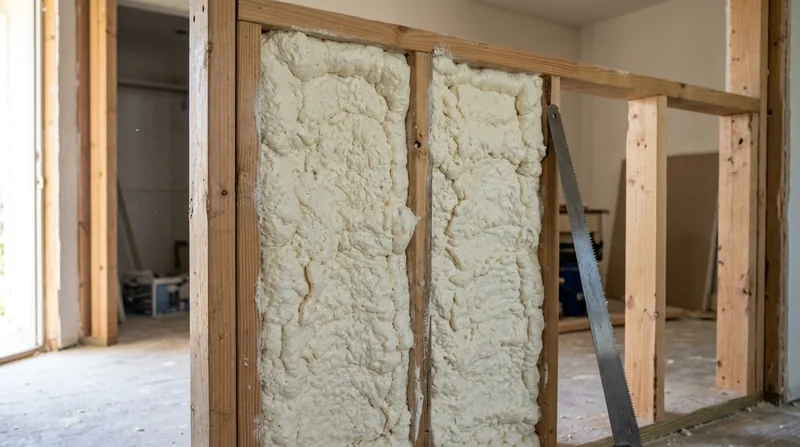




Open Cell Spray Foam Insulation in Austin addresses the core thermal problem of the city's residential stock: vented attics that hit 140 to 160 degrees Fahrenheit through long stretches of 100-degree summer days, pulling conditioned air through every thermal bypass in the house and running cooling systems flat-out. Austin's 1900s-1940s Craftsman bungalows in Hyde Park, Travis Heights, and Clarksville sit on pier-and-beam over open crawl spaces with thin original wall fill; 1950s-60s ranches in Allandale and Barton Hills have empty wall cavities and flattened attic insulation; and the newer growth belt homes from Cedar Park to Kyle are built on concrete slabs with bonus rooms and vaulted ceilings that demand sealed attics. Half-pound open-cell foam air-seals these spaces at a friendlier price per board foot than closed-cell, adds sound dampening between rooms as a bonus, and works best in climate-controlled interiors where moisture vapor can escape to the conditioned space. We spell out where open cell belongs, and where a metal building, pier-and-beam crawl space, or unvented roof deck calls for closed cell instead.
Why Open Cell Spray Foam Matters in Austin's Hot Climate
Austin's summer heat is relentless and the attic is the primary leak point. When a vented attic reaches 150 degrees and your living space sits 20 degrees cooler, the pressure differential pulls air upward through rim joists, wall plates, recessed lights, and ductwork penetrations. Open-cell foam stops that leakage by forming a continuous air barrier across the attic floor, the roof deck, or inside the walls. Unlike blown-in fiberglass, which settles and leaves seams, spray foam conforms to every joist, rafter, and pipe, sealing the gaps that account for 20 to 40 percent of cooling loss in an unsealed attic.
- Open-cell foam expands to fill cavities and conforms to irregular framing, blocking the thermal short-circuits that fiberglass misses.
- The material is breathable once cured, allowing moisture vapor from the interior to escape without trapping condensation in walls or attics.
- Sound dampening between rooms comes standard, a real benefit in bonus rooms, home offices, and multi-generational homes common in Round Rock and Cedar Park.
- Cost per board foot runs 30 to 40 percent lower than closed-cell, making it the practical choice for attic top-ups and interior wall retrofits in existing homes.
In Austin's pier-and-beam neighborhoods and crawl spaces, open cell works well when the crawl space is vented and dry. When standing water, high moisture, or unvented conditions are present, we recommend closed-cell spray foam insulation instead, because closed-cell resists moisture and provides its own vapor barrier.
Key info: A 1,500 square foot attic in a 1960s ranch in Barton Hills with R-19 fiberglass can be topped up with 4 to 5 inches of open-cell foam, raising the attic to R-38 or R-49 and sealing the leaks that the original insulation cannot reach. The air barrier is the payoff, not just the R-value.
For Austin homeowners, the City of Austin Energy Code (Chapter 6, Austin Energy Code) governs attic ventilation, ignition barriers, and thermal barriers for spray foam. A fifteen-minute thermal barrier is required in most attics unless the foam itself meets ignition resistance standards. The local building official at your address determines what applies to your property. We help you navigate what your specific address requires, but always confirm the requirements with your city before we begin work.
For reference, Austin Development Services maintains the current energy code and permitting requirements for the city.
How We Install Open Cell Spray Foam in Austin Attics and Walls
Open-cell foam is sprayed as a liquid and expands in place. The process requires controlled temperature, humidity, and ventilation. We prepare the space, protect HVAC equipment and ductwork, spray the foam in passes of 1 to 2 inches per application, and allow 24 to 48 hours of mechanical ventilation before the space is re-entered. The foam cures fully in a few days, and the property is then returned to normal use.
- We conduct a free on-site estimate, measure the square footage and cavity depths, and identify any moisture, contamination, or substrate issues that must be addressed first.
- We specify the R-value and foam thickness in writing, so you know exactly what you are getting and what it will cost.
- We prep the attic or wall cavity, protecting mechanical systems, ductwork, and exhaust vents from overspray.
- We spray the foam in multiple controlled passes, maintaining manufacturer ratio, drum temperature, and spray pattern to achieve the specified thickness and R-value.
- We run mechanical ventilation during cure and for the re-entry window, preventing the odor that marks poor installation.
- We install any required thermal barrier, such as intumescent paint or drywall, as specified by the local building code.
After cure, the attic is ready for use, and you will notice the temperature difference immediately. Conditioned air no longer escapes upward, and the home stays cooler longer.
Example: A 1950s-60s ranch in Crestview with a 1,200 square foot attic and original R-11 fiberglass receives 4.5 inches of open-cell foam, bringing the attic to R-38. The work takes two days, including cure time. The homeowner sees a 15 to 25 percent drop in summer cooling costs because the air barrier stops the thermal leak that the old insulation could not address.
For wall insulation in pre-1980 homes with empty cavities, we also offer wall and injection foam insulation, which fills cavities without demolition and pairs well with open-cell attic work.
Open Cell Spray Foam Methods and Best Uses
| Approach | Description | Best for |
|---|---|---|
| Attic Floor Spray | Open-cell foam sprayed over the attic floor joists, covering the attic deck and sealing all penetrations. | Vented attics in Austin homes with original or failed insulation, where the goal is air sealing and thermal control without a sealed roof deck. |
| Wall Cavity Fill | Open-cell foam injected into empty wall cavities of brick or stone veneer homes, filling the void without demolition. | 1950s-60s ranches in Allandale, Brentwood, and Barton Hills with empty wall cavities that fiberglass batts cannot reach. |
| Rim and Band Joist Sealing | Open-cell foam sprayed on rim joists and band joists to seal the sill plate and block infiltration at the rim. | Pier-and-beam homes in Hyde Park, Travis Heights, and Clarksville where the rim joist is exposed to outdoor air and heat loss. |
| Crawl Space Walls (Vented) | Open-cell foam applied to the interior of crawl space rim joists and band joists, with the crawl space left vented. | Vented crawl spaces in older Austin homes where moisture is not a primary concern and the goal is insulation and air sealing. |
| Interior Wall Retrofit | Open-cell foam sprayed into interior walls or bonus rooms to reduce sound transfer and improve thermal control. | Bonus rooms and home offices in newer homes in Cedar Park, Round Rock, and Leander where sound dampening and energy efficiency matter. |
Open-cell foam is not the right choice for unvented crawl spaces with moisture issues, metal buildings that sweat, or roof decks where condensation control is critical. Those applications call for closed-cell spray foam insulation, which provides a vapor barrier and resists moisture.
Open Cell Spray Foam Insulation Cost in Austin: What to Expect
Open-cell spray foam is priced per board foot, measured on site after the job is complete. A board foot is one square foot of foam one inch thick. The cost starts at approximately $0.55 to $0.70 per board foot for standard attic applications in Austin, but the final price depends on several factors specific to your home and the scope of work.
The primary cost drivers are:
- Attic size and access: a 1,200 square foot attic with good attic access costs less per board foot than a cramped 800 square foot attic with a small hatch.
- Substrate condition: if the existing insulation is wet, contaminated, or must be removed first, labor and disposal costs rise.
- Thermal barrier requirements: if a fifteen-minute thermal barrier (paint or drywall) is required by code, that adds labor and material.
- Wall cavity fill: injecting foam into walls is more labor-intensive than attic spray, so per-board-foot costs may run higher.
- Distance from Austin: homes in Kyle, San Marcos, or Bastrop may incur travel time, though we include mileage in our standard estimate.
A typical 1,500 square foot attic top-up with 4 inches of open-cell foam runs 6,000 board feet and costs between $3,300 and $4,200, depending on access, existing conditions, and code requirements. Wall cavity fill in a 1,200 square foot ranch might be 2,400 board feet at $1,320 to $1,680. The only way to know your cost is to get a free on-site estimate with written R-value and thickness specifications.
We provide detailed pricing guidance and always give you a written estimate before we schedule the work. Call us at (737) 404-4885 for a free estimate with no obligation.
Open Cell Spray Foam Insulation Near Me: What Austin Homeowners Should Know When Hiring
The spray foam market in Austin includes local independent shops, national franchises, and transient crews that spray a job in an afternoon and disappear. The difference between a good installation and a bad one is visible in the estimate, the process, and the follow-up. Here is what to look for when you call a spray foam contractor in Austin, Round Rock, Cedar Park, or any of our service areas.
Get a written estimate with R-value and thickness specifications. Any contractor who quotes a price without measuring the space or specifying the finished R-value and foam thickness is guessing. A legitimate estimate includes the attic or wall square footage, the foam thickness in inches, the final R-value, and the cost per board foot. If the estimate is vague, move on.
Verify insurance and ask about the installation process. A fully insured contractor carries liability and workers' compensation. Ask how they will ventilate during cure, what the re-entry window is, and whether they will run mechanical ventilation for 24 to 48 hours. If they promise immediate re-entry or skip ventilation, the smell will linger for weeks and the foam may not cure properly.
Confirm what your city requires for permits and thermal barriers. Austin, Round Rock, Cedar Park, and other cities in our service area have different energy codes and thermal barrier rules. A good contractor knows the code at your address and will tell you whether a thermal barrier is required. Do not hire a contractor who says "no permits needed" or "permits are optional". Ask the contractor to confirm with your local building department what applies to your address.
Check references and verify past work. Ask for the names of three homeowners in your neighborhood where the contractor has done similar work in the last two years. Call them and ask about the quality of the installation, the professionalism of the crew, and whether any issues arose after the work was complete.
Understand the warranty and what it covers. A workmanship warranty of one to three years on the installation is standard. Do not expect a lifetime warranty, which is not realistic for any spray foam installer. Ask what the warranty covers (installation defects, adhesion, settling) and what it does not cover (settling due to thermal cycling, moisture intrusion from roof leaks, or damage from future construction).
Get multiple estimates. Call at least two other contractors and compare their estimates, R-values, thicknesses, and prices. A price far below market with no inspection is a red flag. A price far above market with no clear reason is also a warning sign.
For a free estimate with no obligation, contact us or call (737) 404-4885. We will walk you through the process, answer your questions, and give you a written estimate with R-value and thickness specifications before we schedule any work.
Open Cell Spray Foam Insulation in Austin: Pricing Guide
| Service | Price | Details |
|---|---|---|
| Attic Floor Spray (Standard) | Starting at $0.55/board ft | Vented attic, good access, no existing contamination, thermal barrier included per code |
| Wall Cavity Injection Fill | Starting at $0.65/board ft | Empty wall cavities in brick or stone veneer homes, labor-intensive, no demolition required |
| Rim Joist and Band Joist Sealing | Starting at $0.60/board ft | Pier-and-beam homes, crawl space rim and band joists, vented conditions, air sealing priority |
| Crawl Space Walls (Vented) | Starting at $0.60/board ft | Vented crawl space, no standing water, moisture not a concern, air sealing and insulation |
| Complex or Large-Scale Job | On estimate | Attic removal required, wet substrate, sealed roof deck, unvented conditions, or multiple zones |
| Free Estimate | No charge | Response within 24 hours, written R-value and thickness specs, no obligation to proceed |
Indicative pricing, the exact cost depends on square footage, finish, and site access. Free personalized estimate within 24h at (737) 404-4885.


