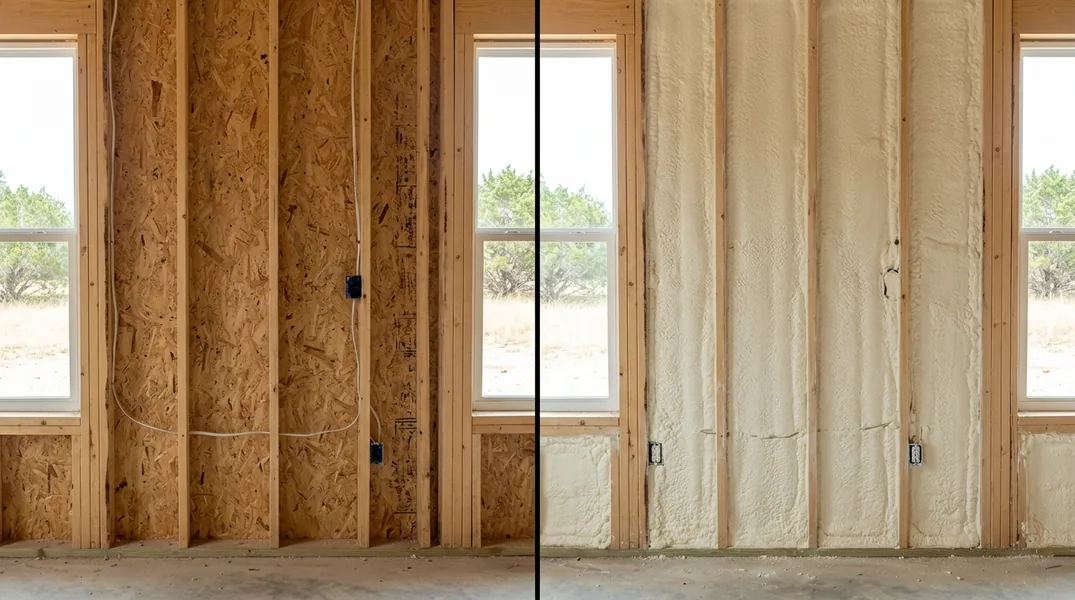
Understanding R-Value Requirements by State and Local Austin Standards
When it comes to insulation, R-value is the metric that matters most. R-value measures thermal resistance, or how effectively a material slows heat transfer. The higher the R-value, the better your insulation performs. However, not all insulation materials deliver the same R-value per inch, and that's where spray foam stands out as a premium choice for homeowners in Austin looking to maximize efficiency.
Attic Spray Foam Insulation delivers approximately 3.5 to 3.6 R-value per inch for open cell foam and 6.0 to 7.0 R-value per inch for closed cell varieties. This compares favorably to fiberglass batts, which typically offer 3.2 to 3.8 R-value per inch. Texas doesn't have a statewide mandate for attic insulation R-value, but the International Energy Conservation Code (IECC), which many municipalities adopt, recommends R-38 to R-60 for attic insulation depending on climate zone. Austin falls into a warm climate zone, which typically requires R-30 to R-38 minimum. Understanding your local building codes is essential before upgrading your insulation.
How Thick Should Spray Foam Be for Maximum Efficiency and Rebates
The question of thickness directly ties to R-value performance and your eligibility for energy rebates. If you're installing Open Cell Spray Foam Insulation, you'll need approximately 10 to 11 inches to achieve R-38, or 13 to 15 inches for R-50. With Closed Cell Spray Foam Insulation, you can reach R-38 with just 5.5 to 6 inches, making it ideal for tight spaces or when you want superior performance in a thinner application. Most energy rebate programs in Texas reward installations that meet or exceed the IECC baseline, so thicker isn't always necessary if you choose a higher-performing material.
For attic applications, Austin homeowners typically benefit most from 5 to 7 inches of closed cell foam or 10 to 12 inches of open cell foam. The choice depends on your budget, available space, and desired R-value. Thicker applications cost more upfront but deliver better long-term energy savings and stronger qualification for tax credits and rebates. When you're planning your upgrade, getting a professional assessment helps determine the optimal thickness for your specific home and climate.
Federal Insulation Tax Credits and State Rebates Available in 2026
The federal government continues to incentivize home energy improvements through the Attic Spray Foam Insulation tax credit program. As of 2026, homeowners can claim up to 30 percent of the cost of qualifying insulation improvements, with a maximum credit of 3,200 dollars per year. This credit applies to spray foam and other insulation materials that meet specific energy performance criteria. The investment tax credit is non-refundable but can be carried forward to future years, making it a valuable deduction for homeowners undertaking major efficiency upgrades.
Beyond federal credits, Texas offers state-level incentives through utility rebate programs. Many electric cooperatives and municipal utilities in the Austin area provide direct rebates for attic insulation upgrades. These rebates typically range from 200 to 800 dollars, depending on the R-value achieved and your utility provider. Combining federal tax credits with state and local rebates can offset 40 to 50 percent of your total project cost. It's essential to verify that your chosen contractor and materials are on the approved list for your specific utility provider before beginning work.
What ECAD Audits Reveal About Your Insulation Gaps
An ECAD (Energy Code Audit) is a detailed assessment of your home's energy performance against current building codes. These audits identify insulation deficiencies, air leakage points, and other thermal weaknesses that drive up your utility bills. During an ECAD audit, professionals measure existing R-values, identify missing or compressed insulation, and recommend upgrades needed to meet 2026 energy standards. For homeowners in Austin, an ECAD audit often reveals that older attic insulation has settled or become ineffective over time.
The audit report becomes your roadmap for maximizing rebate eligibility. Many utility companies require an ECAD audit or energy assessment before approving rebate applications. The audit documents your baseline energy performance and proves that your upgrade meets the required R-value threshold. This documentation is also critical for claiming your federal insulation tax credit. When you work with Austin Spray Foam Insulation, we can help coordinate with your utility provider to ensure your project qualifies for all available incentives.
Spray Foam Insulation Cost in Austin: What to Budget for 2026 Projects
Understanding the cost structure of spray foam insulation helps you make informed decisions about your energy upgrade. Closed Cell Spray Foam Insulation typically costs between 1.50 and 2.50 dollars per board foot, while open cell foam ranges from 0.50 to 1.00 dollars per board foot. For a typical 1,500 square foot attic, you might expect to spend 2,000 to 4,500 dollars for closed cell foam or 1,500 to 3,000 dollars for open cell foam, depending on thickness and local labor rates. However, after applying federal tax credits and state rebates, your net cost drops significantly.
The true value of spray foam becomes clear when you factor in energy savings. Homeowners typically recover their investment through reduced heating and cooling costs within 5 to 8 years. Beyond that payback period, you're enjoying pure savings on your utility bills. For a detailed breakdown of costs specific to your home, we recommend contacting Austin Spray Foam Insulation at (737) 404-4885 to schedule a free estimate. Our team will assess your current insulation, calculate the R-value you need, and provide transparent pricing that accounts for available rebates and tax credits.
Next Steps: Getting Your Home Ready for 2026 Energy Standards
Preparing your home for 2026 energy standards starts with a professional evaluation. Whether you need attic insulation, Wall & Injection Foam Insulation, or a comprehensive energy upgrade, the first step is understanding your current situation. An energy audit or ECAD assessment reveals exactly where you stand and what improvements will deliver the best return on investment. Most homeowners are surprised to learn that their existing insulation has settled or degraded far more than they realized.
Austin Spray Foam Insulation specializes in helping homeowners navigate the rebate and tax credit landscape while delivering superior insulation performance. Our team stays current on federal incentives, Texas state programs, and local utility rebates to ensure you capture every dollar of available savings. Contact us today at (737) 404-4885 or request a free estimate to learn how spray foam insulation can improve your home's efficiency while maximizing your 2026 tax credits and rebates. The time to act is now, before energy standards become even more stringent.
Looking for a professional spray foam insulation contractor in Austin? Austin Spray Foam Insulation responds fast for all your spray foam insulation needs.
Get a Free Quote